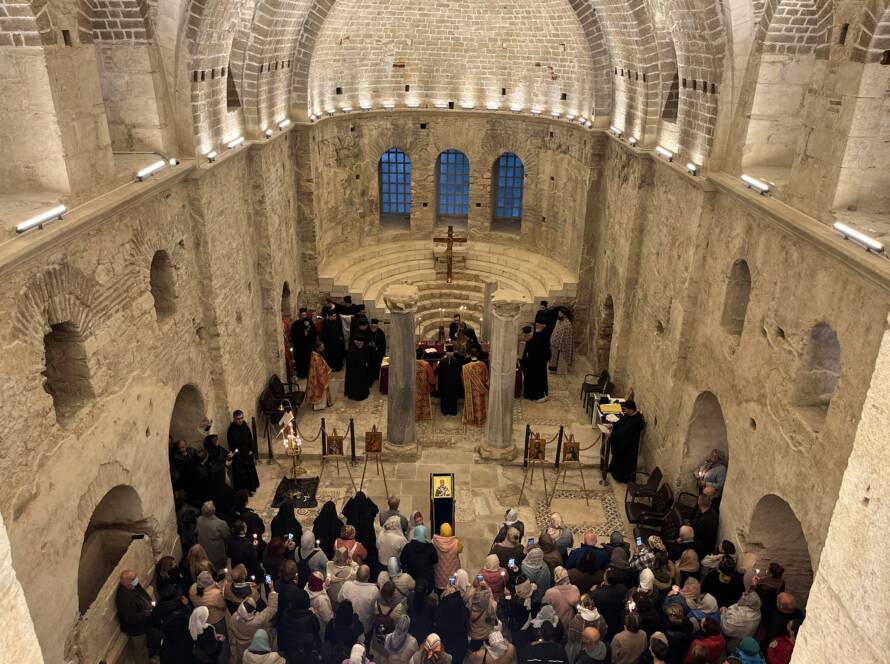
Antalya, November 15, 2026
The first reading for tonight’s service is taken from the beginning of the covenant blessings in Leviticus 26, pronounced by God to Moses on Mount Sinai as a conditional agreement with the Israelites before their entry into the land of Canaan. After establishing the moral, civil, and ritual laws, God sets the conditions for their survival and prosperity in the Promised Land. It is striking to note in this passage that the land itself responds to the moral and spiritual state of its inhabitants.
Obedience brings ecological harmony and peace with neighboring enemies: “If you walk in my ordinances and keep my commandments and do them, I will give you rain in its season and the earth will give its produce and the trees of the plains their fruit. And your threshing time will overtake the vintage, and the vintage will overtake the sowing. And you will eat your bread to the full and dwell in safety on your land” – says the Lord. On the contrary, disobedience leads to drought, famine, military defeat, and ultimately, exile: “if you will not listen to me, nor observe these ordinances of mine, but disobey them, and if your soul loathes my judgements, so that you do not keep all my commandments, I in turn will do thus to you: I will bring distress upon you, and you will sow your seed in vain and your enemies will devour your labours” – says the Lord.
In light of Leviticus 26 and other sacred texts, human ethics and the physical environment are deeply intertwined. Transgression of God’s commandments leads directly to ecological collapse: “I will make your heavens like iron and your earth like bronze” – says the Lord, signifying extreme drought and arid lands. Many contemporary theologians and religious leaders, such as the late Pope Francis of blessed memory in his encyclical Laudato Si’ and Ecumenical Patriarch Bartholomew, perceive the ecological crisis and the problem of climate change as a reflection of humanity’s failure to fulfill its duty of responsible stewardship. Indeed, as we read in the Book of Genesis: “The Lord God took the man and put him in the Garden of Eden to work it and take care of it” (Gen. 2:15). From this perspective, God has commanded humanity to care for and protect his creation.
In light of this, greed, overconsumption, and the exploitation of natural resources are considered forms of spiritual disobedience to this original commandment, leading to climate change. When humans violate the principles of moderation, justice, and respect for creation, the natural world suffers. In this sense, a fundamental principle formulated by His All-Holiness Ecumenical Patriarch Bartholomew, often refered as the “Green Patriarch,” affirms: Committing a crime against the natural environment is a sin against God. This principle is rooted in the conviction that all of creation, the natural environment, belongs to its Creator, and that humanity must be its guardian and protector rather than its absolute owner or consumer. Thus, Ecumenical Patriarch Bartholomew popularized the concept of “ecological sin,” arguing that harming biodiversity, polluting the atmosphere, and contributing to climate change are moral failings that reject God’s gift of creation. This idea was taken up by Pope Francis in 2015 in his famous encyclical Laudato Si’, where he explicitly quotes the Green Patriarch and affirms that mistreating the earth violates the divine mandate given to humanity to “cultivate and take care of” the garden (Gen. 2:15). As with all sins, it is our duty to repent by changing our way of life.
It is worth recalling here the initiative of the Ecumenical Patriarchate, taken by the late Ecumenical Patriarch Dimitrios of blessed memory in 1989, to institute September 1st, the first day of the ecclesiastical year in the Orthodox Church, as a day of prayer for the protection and preservation of the natural environment. The institution of such a day of prayer was subsequently adopted by the World Council of Churches (WCC), the Conference of European Churches (CEC), the Roman Catholic Church, the Anglican Communion and the Lutheran World Federation. In 1990, the Ecumenical Patriarchate commissioned a renowned hymnographer from the Church of Constantinople, the monk Gerasimos of the small skete of Saint Anne on Mount Athos, who died a year later in 1991 and was canonized as a saint in 2023, to compose a liturgical service of supplication and prayers for the protection of creation. This service was published in 1991, and it is precisely this liturgical service that we celebrate tonight on the occasion of COP31, here, in this small church of Saint Alypios the Stylite, built in 1844 as a private chapel of the Danielidi family, great benefactors of the time, and bought back by the Ecumenical Patriarchate in 2009 and now being the see of the Metropolis of Pisidia, serving the spiritual needs of thousands of Orthodox Christians living now a days in the Antalya region.
COP31, the 31st United Nations Climate Change Conference, which brings together world leaders, negotiators, scientists, and representatives of civil society this month here in Antalya under the motto “Where Dialogue Turns into Global Action”, is attempting to turn past climate commitments into concrete actions. We pray for its success and the implementation of its decisions. However, we, as Christians, must recognize that we are all responsible for the preservation of creation, and that it is up to each one of us to repent of the “sin against creation” by changing our behavior and our way of life.
As human beings called to be stewards of creation. Let us therefore become responsible “priests of Creation,” offering creation to God with gratitude, in a Eucharistic spirit, rather than exploiting or overconsuming it. Let us free ourselves from the greed, self-centeredness, and spiritual blindness that characterize the accumulation and excessive exploitation of resources, all of which lead to environmental degradation, by cultivating an ascetic spirit that advocates voluntary simplicity, fasting, and self-control as an antidote to modern consumerism.
And thus, keeping the ordinances and commandments of the Lord, we shall receive from him every blessing: he shall give us rain in its season and the earth will give its produce and the trees of the plains their fruit, and the vintage will overtake our sowing, and we shall eat our bread to the full and dwell in safety on our land. To Him who created all things with wisdom, glory and adoration to the ages of ages. Amen.