
Setting Out on the Journey
As we approached Mount Athos by sea, the first thing to change was not the landscape but time. The shore slowly withdrew from the hurried measure of everyday life. The monasteries set between forest and sea looked less like buildings than signs of another rhythm. The time shown on my mobile phone was still with us, and messages still arrived now and then, but the hold of that magnetic machine had begun to weaken. From the very start of the journey, I felt the Holy Mountain loosening the pressure that our worldly habits exert upon us. Yes, we had entered a new experience of time.
We reached Vatopedi on 11 September, Xenophontos on 12 September, and Simonopetra on 13 September. Each of those three days opened a different door. At Vatopedi, the meaning of time changed; at Xenophontos, the meaning of the face and body; and at Simonopetra, the meaning of stone and memory. At the first I saw that the hours can be turned toward God; at the second, that where there are no mirrors, a person’s face is the face of his brother; and at the third, that a monastery stands not merely by virtue of its walls but through the faithfulness that rebuilds it after every disaster.
It would be incomplete to describe Mount Athos solely as an architectural inheritance or an extraordinary place. This was neither a tourist outing nor an ordinary journey undertaken out of religious zeal. Here everything visible is bound to the invisible. A bell does more than announce the hour: it summons us to prayer. A meal does more than satisfy hunger: it disciplines appetite. An ossuary does more than recall death: it tests our faith in the resurrection. A library does more than store books: it preserves time lived in worship. And a cave is more than a hollow in the rock: sometimes it is the womb from which an entire brotherhood is born.
The feasts to which the three monasteries are dedicated also traced the journey’s invisible map. Vatopedi is dedicated to the Annunciation to the Theotokos, Xenophontos to Saint George the Victorious, and Simonopetra to the Nativity of Christ. The Annunciation tells of God entering human time; Saint George, of faithfulness in the face of death; and the Nativity, of the Eternal One entering the confines of a cave. I realized later that the images of clock, bone, and rock I had encountered throughout the visit had gathered around these three feasts of their own accord. This is therefore more a pilgrimage journal than a travel article. I have tried to distinguish historical information from personal memory and to recount the miracles told in monastic tradition as the memory of a believing community rather than as documentary history. For on the Holy Mountain, truth is carried not only in archives but also in bodies at prayer, repeated hymns, a monk’s smile, and a holy relic kissed over centuries.
Vatopedi The Annunciation Entering Time
When the fullness of time had come, God sent forth his Son
Galatians 4 4
Stone Dedicated to the Annunciation
On entering Vatopedi, my first impression was not so much its size as its layers. Its stone walls, courtyards, towers, and chapels each carried the voice of another century. Founded sometime around 972–985 and holding an important place in the hierarchy of Mount Athos, the monastery bore the weight not only of its age but also of the memory of worship accumulated over centuries. Its main church, the katholikon, was dedicated to the Annunciation to the Theotokos. The many chapels around it made the great complex more than a single place: they formed a network of prayer extending across the hours of the day and the seasons of the year.
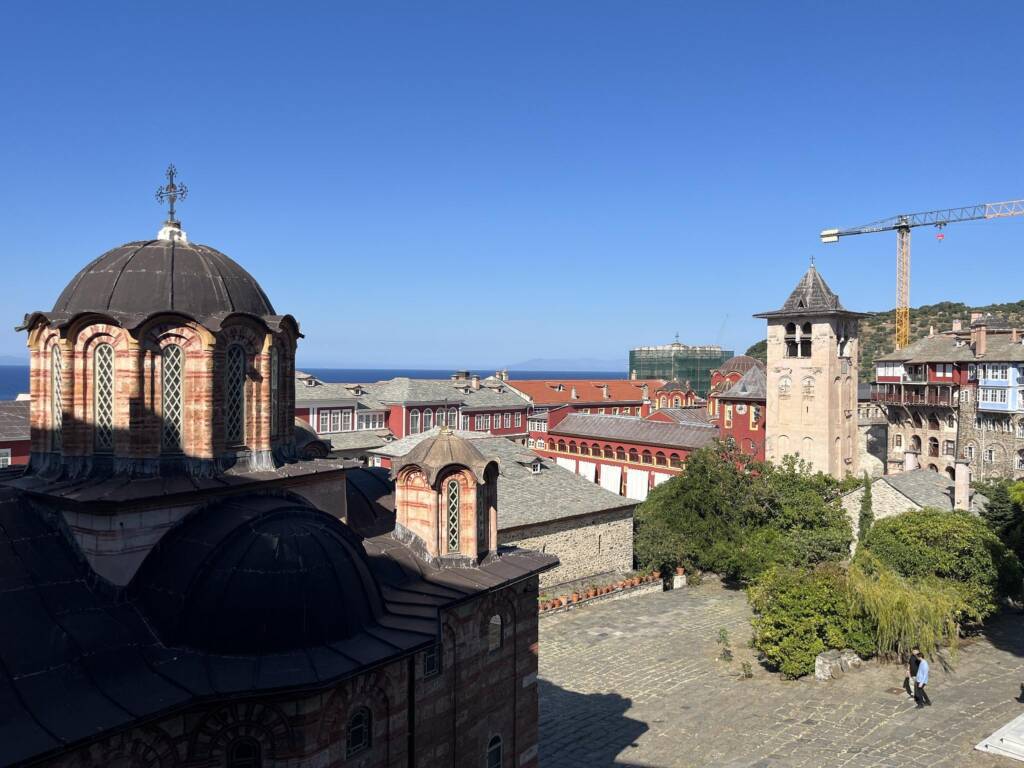
Looking at the clock tower in the courtyard, I noticed a metal figure beside the clock. From a distance its clothes resembled those of a Janissary, as though a soldier were standing guard over time. Here, however, observation must not be confused with historical fact. The monastery’s description does not identify the figure as a particular Janissary or historical person. It is a clock automaton dating from around the seventeenth century, described in older sources as a metal Arab figure, which once struck a small bell mechanically. This soldier, a reminder of death, stood there to announce that death draws nearer with every passing hour. When I asked the Australian monk who attended to us and showed us around the monastery in such detail, he confirmed this interpretation. That, he said, was why the figure was still there and had not been removed. The automaton no longer works, but the sword at its waist is enough to remind us of death.
The Silence of the Sundial
Beside the mechanical clock, the sundial offered another lesson. One spoke through gears, a hammer, and the sound of metal; the other worked only with shadow. The shadow changed length, and the lines on the stone took on meaning in the light. A human measure could say nothing unless it was connected to the greater rhythm of creation. The sun was measuring not only time; it was also teaching obedience and order.
This order led me to think that the difference between God’s time and human time is not a matter of two time zones. The difference lies in whom our hours belong to. The same sixty minutes could become anxiety in a city and repentance here. The same night could be an extension of entertainment outside and a place of watchfulness inside. I thought about this: technology saves us so much time. A task that would once have taken days can be completed on a computer in two days and printed immediately. We need not write a letter; we can send a message to the other side of the world in thirty seconds. And that is without even mentioning air travel. So how do we use all the time we have saved? The question is not how much time we have, but what we spend it on. The monastery clock did not give us more time; it gave time a direction.
Restraint and Thanksgiving at the Table
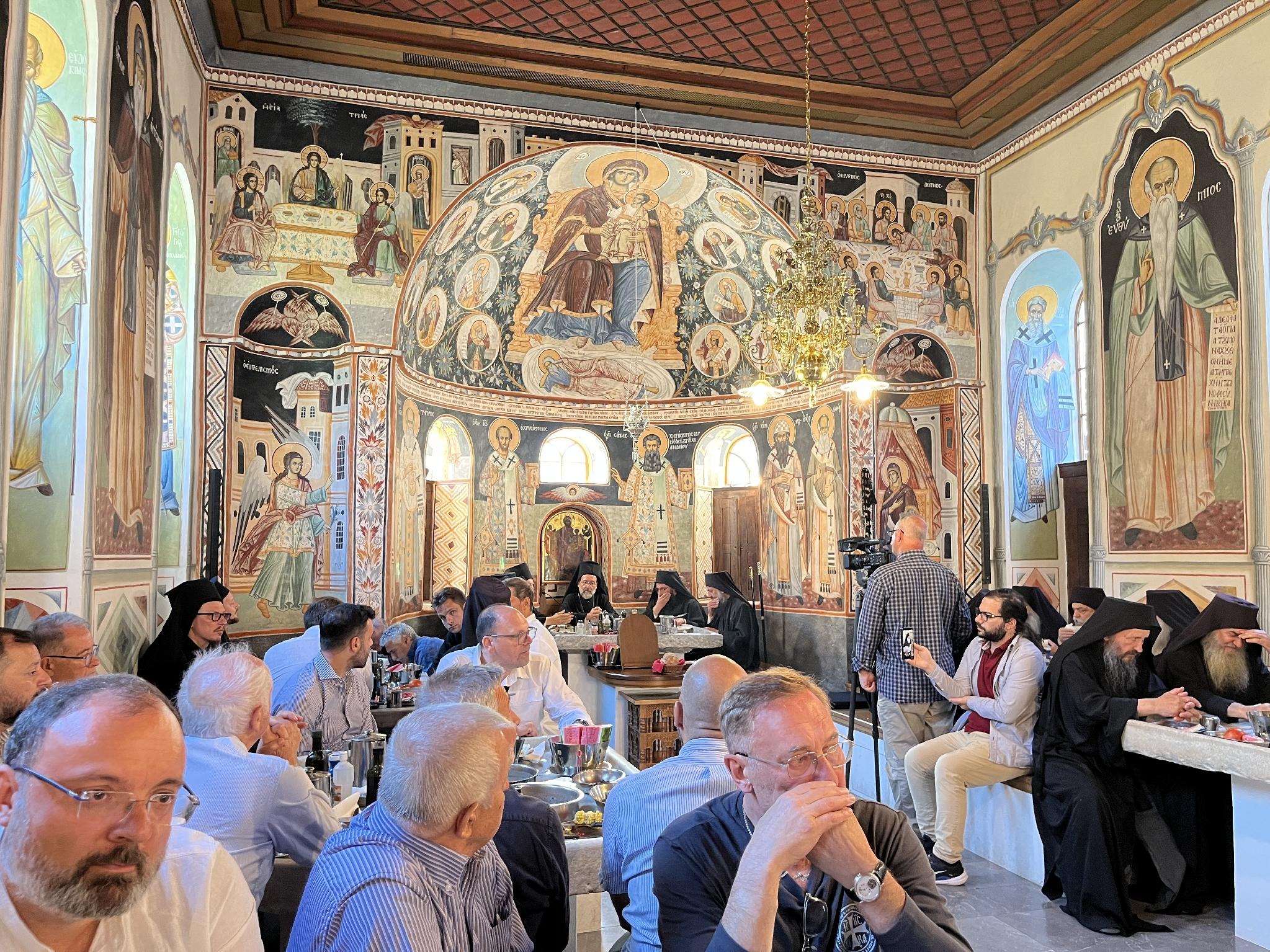
I felt this sense of direction most clearly in the refectory. After the prayer and blessing, everyone took a place and the meal began; the silence became almost as noticeable as the food itself. A reader’s voice filled the room, while the sound of spoons and plates receded into the background. A meal here was not an occasion to prolong conversation or multiply pleasures of the palate. The body received what it needed, while the mind was nourished by the words being read.
The meal ended sooner than I had expected. At a signal everyone stood up together. Anyone who had eaten slowly could not remain alone with his plate as he might in everyday life; he had to follow the shared rhythm of the table. That small detail showed clearly the difference between modern consumer culture and monastic life. Outside, eating is increasingly surrounded by images, choices, and entertainment. Here, the gift of food was received without becoming the center of attention. The table expressed thanksgiving, not hostility to pleasure. Limiting appetite here restores the body to the service of the person instead of leaving it an object of the marketplace and of passing desires. The restraint I saw at the table gave me a practical understanding of freedom: before we can choose everything we want, we must learn to be masters of our desires.
Holy Relics and Resembling Faces
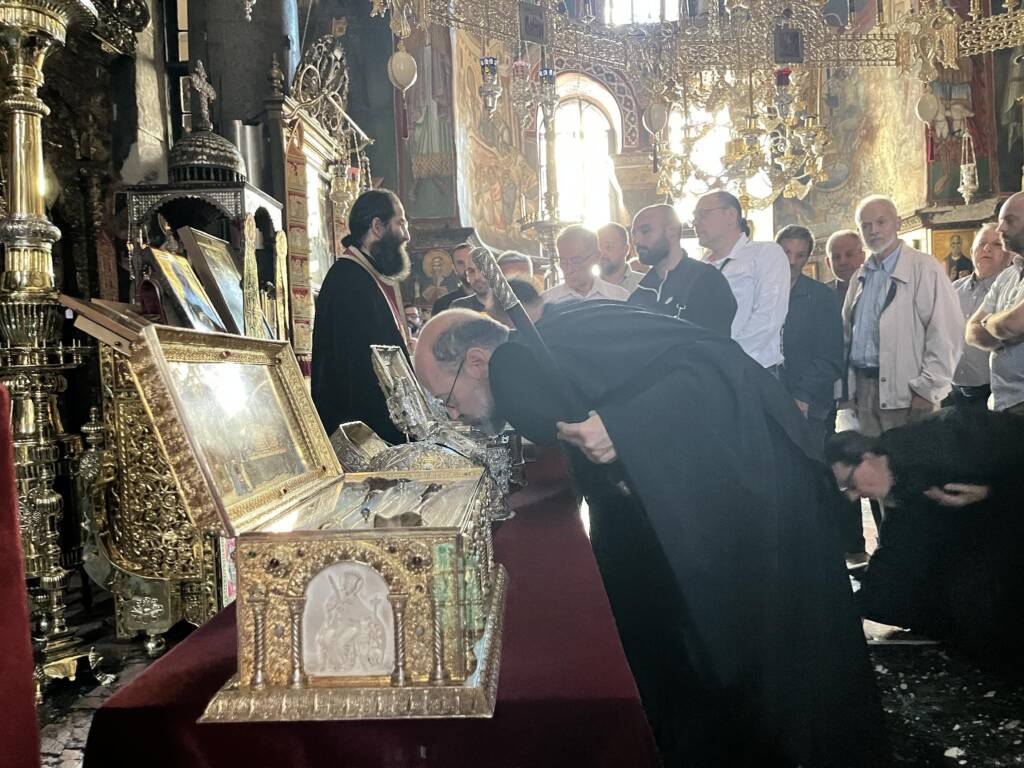
Vatopedi’s importance lies in more than its imposing buildings. According to the monastery’s tradition, it preserves a portion of the Holy Girdle of the Panagia, a fragment of the True Cross, the reed associated with Christ’s Passion, the holy heads of Saint Gregory the Theologian and Saint John Chrysostom, and relics of many other saints. Praying before the relics at Vatopedi offered an initial answer to a question I would face shortly afterward in the ossuary at Xenophontos: the body is mortal, but it is not insignificant; it returns to earth, but it is not erased from God’s memory. I was sorry that I could not take photographs as I prayed before and venerated the holy relics. So I spent a long time looking at a photograph in Vatopedi’s museum showing a community of monks on a day in 1928 when the relics were brought out. Some of the faces in the photograph could have belonged to monks I had just seen in the courtyard.
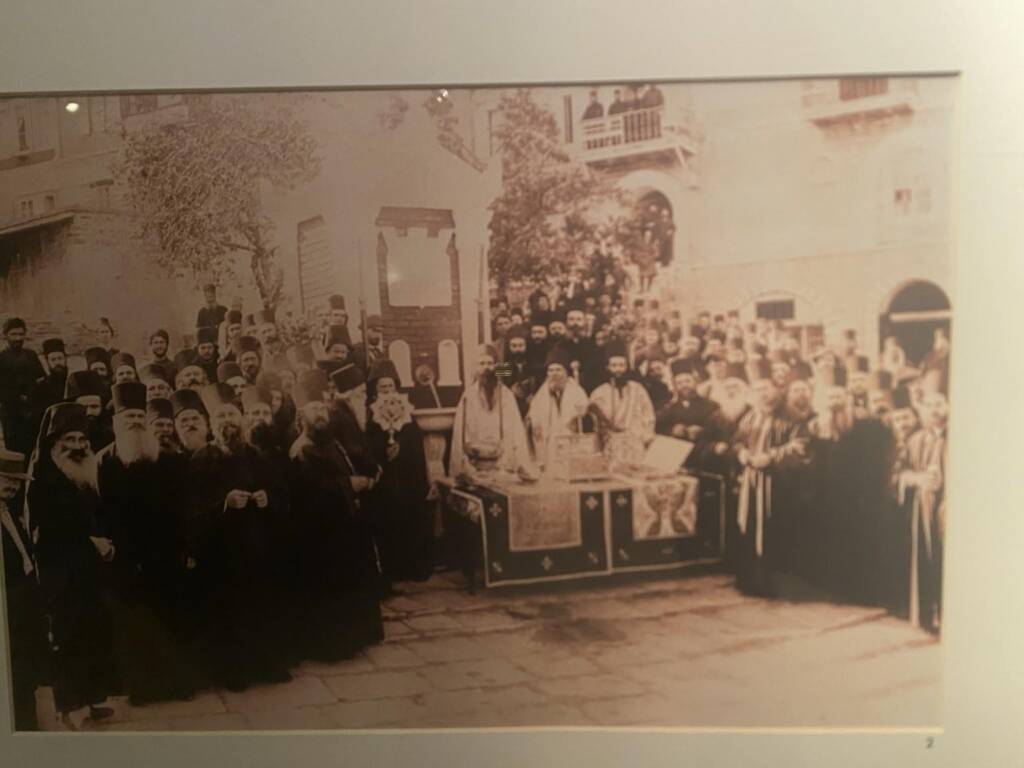
This resemblance did not mean a loss of personhood on the Holy Mountain; it reflected a shared direction. In the city we continually reshape our hair, clothes, and appearance to distinguish our faces from those of others. Here, people of different nationalities and temperaments look toward the same goal, and their outward forms gradually come to resemble one another. Each face remains unique, yet it no longer needs to announce itself. As I left Vatopedi, I carried a question with me: Does looking more often at our reflection really help us know ourselves better, or do we sometimes come closer to the person behind the face when we stop looking?
Xenophontos Faces Unseen in the Mirror and the Mirror of Bones
People look at the outward appearance, but the Lord looks at the heart
First Samuel 16 7
In the Shadow of Saint George
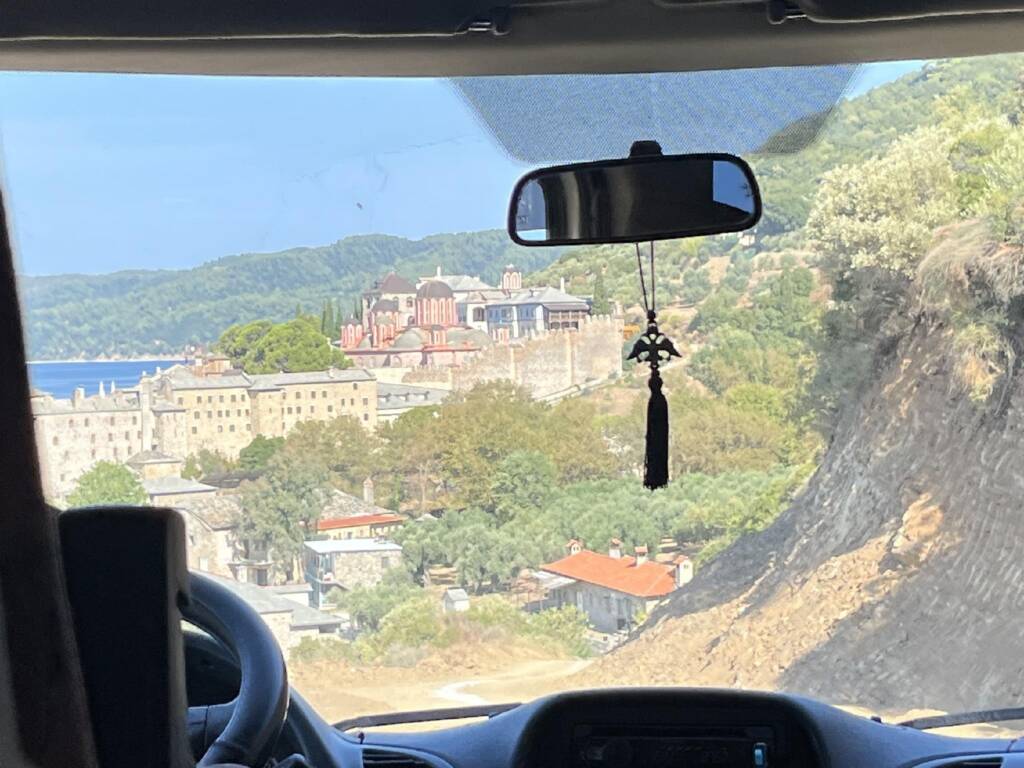
Xenophontos Monastery is dedicated to Saint George the Victorious. Both its old and new main churches bear his name. While the old katholikon preserves the memory of earlier Byzantine centuries, the new one, begun in 1817, stands among the largest churches on Mount Athos. The presence of two main churches in the same courtyard seems an architectural expression of growth without abandoning the past. The smaller, older church has not fallen silent; the larger, newer one does not make it obsolete. According to the church and treasury traditions, a fragment of the True Cross, relics of Saints George and Demetrius, the holy head of Saint Tryphon, the right hand of Saint Marina, and relics of other saints are kept here. The icons of the Theotokos known as Hodegetria and Kecharitomene receive particular veneration. The monastic tradition that the Hodegetria icon came from Vatopedi to Xenophontos forms an invisible bond between the two monasteries. Here that bond would deepen the thoughts about body, face, and holy relics that had begun to form in my mind at Vatopedi the day before.
Life Without Mirrors
In the modern world, the face and body have become an almost continuous project. Mirrors, phone cameras, filters, cosmetic procedures, and measurements constantly ask us how we look. The body can cease to be a gift to care for in good health and become a display to exhibit and compare. We recognize our own face but can forget toward whom it is turned. In the past, mirrors were absent from monastic life. They are now used in very limited ways, but they are far from the center of daily attention. The monk’s aim, of course, is not neglect of his appearance; he seeks freedom from revolving around his own image. In the Orthodox tradition, a person is not a closed individual but a unique being who opens toward God and neighbor. The truth of a face emerges in encounter, not on the surface of glass.
The Cheerful Keeper of the Ossuary
At Xenophontos, after we had prayed at the grave of the late Metropolitan Ezekiel of Pisidia, we entered the place where bones and skulls are kept. The cool stone walls, dim light, and orderly shelves immediately drew us into a different kind of silence. In the monasteries of Mount Athos, deceased monks are first buried. Years later their bones are exhumed, cleaned, and kept in the ossuary. Skulls are usually placed on shelves and long bones in separate compartments. This arrangement is not an exhibition designed to frighten visitors; it is a way for the brotherhood to remember its departed members.
I might have expected the person responsible for such a dark, somber place to be silent, grave, and withdrawn. Yet the monk we met here, Spyridon, was among the most cheerful and talkative clergy we encountered at any of the monasteries. His voice did not deny the weight of the place, but neither was it crushed by it. A monk smiling and speaking cheerfully in front of shelves of skulls may seem a contradiction at first. In fact, he offered a very simple expression of the Christian understanding of death.
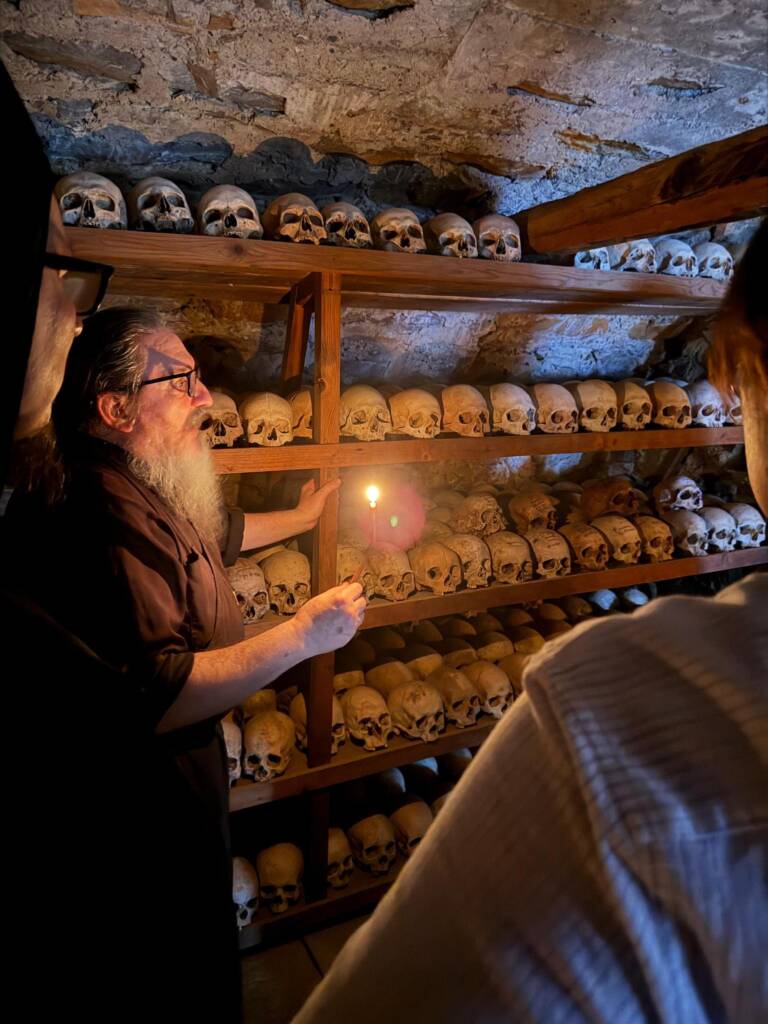
To remember death is not to surrender to it. Saint John Climacus treats the remembrance of death as an aid to repentance and watchfulness. Its purpose is not to breed gloom but to diminish false claims to importance. Someone who remembers the end does not magnify every argument, carry every insult, or imagine that every possession will belong to him forever. Perhaps this was the source of Spyridon’s joy.
Barlaam’s Walking Stick
The story of Barlaam told by Father Spyridon completed this thought through humor. Barlaam was an elderly monk who had entered the monastery very young and spent his entire life there. At the time, the monastery had no mirrors. Since his youth he had scarcely looked closely at his own face. He had not spent the years tracking his whitening hair and deepening lines as a project of appearance. His face had changed, but the direction of his life had not.
One day a French documentary crew visited the monastery. After filming, the completed documentary was shown to the monks. As elderly Barlaam watched the monastery courtyard, his brothers, and their daily life on the screen, he suddenly saw something familiar: the walking stick he had carried for years. He did not realize that he himself was the old monk holding it. He sprang to his feet and protested:
That monk has stolen my walking stick!
The comedy of the story is plain, but its innocence runs deep. Barlaam recognized his stick because he used it every day. He did not recognize his face because he did not spend every day gazing at it. The world teaches the reverse. We look constantly at our faces yet readily forget what sustains us. Barlaam’s mistake was funny, but ours may be more serious: mistaking our image for our self and failing to recognize the invisible grace that carries our lives. This story expresses no contempt for the body. Barlaam’s aged face was as real as his stick. But his face had ceased to be the center of his identity. A monk who did not look at himself in a mirror every day had probably seen the faces of his brothers more often. Perhaps when we are less captive to our own image, we can make more room for others. Monastic life offers a living example of that possibility.
The Equality Taught by Skulls
Looking at the skulls arranged on the shelves of the ossuary, one sees clearly how short lived are the differences in appearance to which we devote so much effort in this world. Youth, beauty, class, rank, nationality, and wealth become indistinguishable in the silence of bone. People who once had distinct eyes, voices, walks, and habits now appear almost identical in form. The mirror enlarges differences; the ossuary reveals our common end.
But does Christian equality mean an anonymity that makes people interchangeable? I do not think so. Although the skulls look alike to us, the name, prayer, and story of each monk retain a distinct place in the brotherhood’s memory. More importantly, God knows each of them by name. Death erases the body’s social appearance, but it cannot erase a person from divine memory. The likeness in the ossuary therefore does not say, ‘No one matters.’ It says, ‘No one is more valuable than another because of outward appearance.’ Holy relics brought a third meaning to the ossuary. The face in the mirror shows how we appear; the ossuary, what we shall become; and holy relics, what God’s grace calls us to become. The same bone can be a sign of mortality in one place and of holiness in another. The difference lies not in the kind of matter but in the direction of a life. In Saint George’s monastery, true beauty appeared not in a flawless face but in the light of a life faithful to the end.
Simonopetra A New Bethlehem Above the Abyss
You yourselves, like living stones, are being built into a spiritual house
First Peter 2 5
A Monastery Suspended from the Rock
Seen from afar, Simonopetra inspires a sense of impossibility before one even notices its architecture. Its many stories rise upon a granite rock some three hundred metres above the sea; the building seems less to stand on the precipice than to cling to it. The balconies and floors piled above one another on the eastern side exceed human scale when measured against the empty space below.
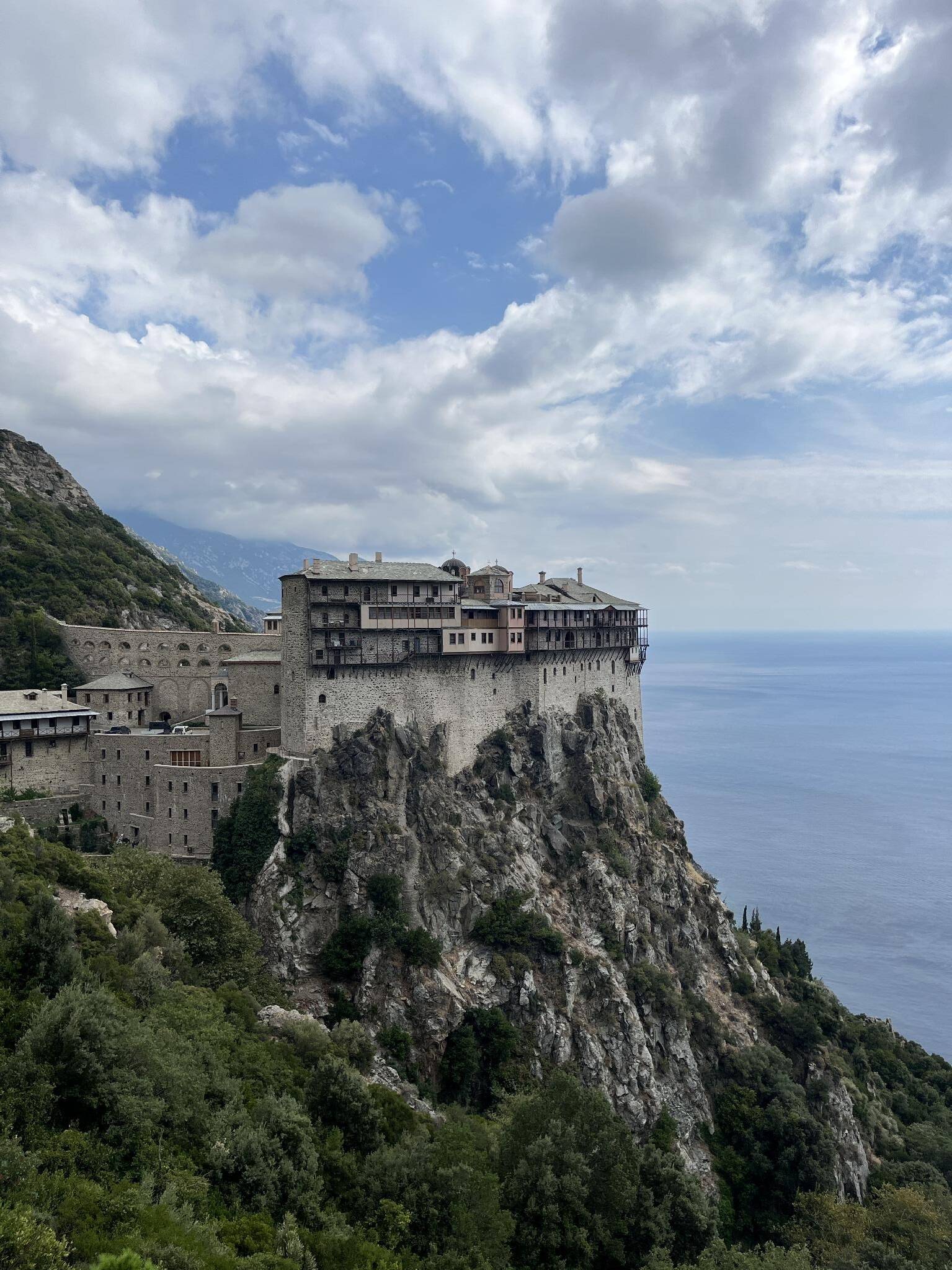
Yet it would be mistaken to imagine the building before us as a single, untouched medieval miracle. Simonopetra’s present appearance is the sum of fires, repairs, and rebuilding. In particular, large parts of the eastern wing and its wooden balconies were renewed between 1897 and 1902 after the fire of 1891. To my mind, its extraordinary architecture lies precisely in this miracle of renewal and preservation.
A Worldly Face in the Reception Room
As soon as we entered the monastery, the abbot received us in the guest reception room. While coffee was served, I looked at the pictures of saints and deceased abbots on the walls. One engraving immediately caught my eye. Its subject was portrayed with the resolve of a worldly ruler rather than the iconographic stillness of a saint, and his clothes resembled those of no spiritual figure I had seen before.
When we finished our coffee and it was time to leave the room, I quickly rose and went over to the engraving. The name beneath it surprised me: Mihai Viteazul. At first I read it in my mind as ‘Mikhail Vitaul’ and wondered why a Romanian king was hanging among the saints and departed abbots. When I asked Hieromonk Makarios, he explained that this man had been one of Simonopetra’s great benefactors and had helped the monastery survive a difficult period.
The man in the engraving was not a Romanian king in the modern sense. He was Mihai Viteazul, Michael the Brave, voivode of Wallachia between 1593 and 1601. After a devastating fire caused by lightning in 1580, Abbot Eugenios sought help. Michael contributed substantially to the rebuilding and, in a document dated 1599, assigned the Mihai Vodă Monastery in Bucharest and its dependent properties to Simonopetra. The engraving’s place in the room was therefore one of memory, not iconography. He was present there as a protector and benefactor, not as a saint.
In Hieromonk Makarios’s oral account, particular emphasis fell on Mihai’s help with the heavy taxes that the Athonite monasteries had to pay under Ottoman rule. During that era Mount Athos preserved its special legal position and internal order while facing pressures from taxes, debt, and property disputes. Wallachian and Moldavian voivodes, Serbian and Russian rulers, merchants, and ordinary believers came to the aid of its monasteries at different times. The Holy Mountain’s continuity is the work of solidarity sustained across centuries, not of one hero alone. Yet there was clearly a special bond of faith between Michael the Brave and Simonopetra.
Simonopetra’s history is marked by major fires in 1580, 1622, and 1891. One of the most devastating, the fire of 1891, began in the bakery and destroyed the eastern wing, the main church, the library, the guesthouse, the abbot’s quarters, chapels, the infirmary, and cells. Hundreds of manuscripts and printed books turned to ash. Even so, the monks managed to save the holy relics, some documents, and liturgical objects. This history changes how we understand the monastery’s preservation. If we think a miracle can only mean that disaster never occurs, we cannot understand Simonopetra’s story. To me, this is precisely where the true miracle lies: not in the monastery never burning, but in its rising again after every fire. Divine providence appeared here in the courage of the monk returning to the flames, the gift of a distant voivode, the labor of a worker carrying stone, and the faithfulness of a brotherhood singing hymns again after the ashes. To me, that is a great miracle.
One of the monastery’s most precious relics is the left hand of Saint Mary Magdalene, the myrrh bearer, believed to remain incorrupt. It has been in the monastery since at least the seventeenth century and is said to be warm and fragrant. You can feel the warmth when you venerate it. The hieromonk responsible for the relics told us that it maintains a temperature of thirty seven degrees Celsius under all conditions. Records state that North African pirates abducted the relic for ransom in 1747 and that, roughly twenty years later, Abbot Ioasaph recovered it by paying a ransom in Tripoli. Even this small detail shows that life on Mount Athos has involved not only the quiet of prayer but also pirate attacks and the fear of loss.
Closeness Within the Rule
Of the monasteries we visited, Simonopetra was where the rules felt clearest and least negotiable. Hours, entry into particular spaces, the order of worship, silence, and the movements of guests were all governed by distinct boundaries. It would be wrong to turn our experience into an objective ranking and call it ‘the strictest monastery on Mount Athos.’ But discipline was more visible here than elsewhere during our visit.
Even so, the warmth shown by the hieromonks did not conflict with the rules. On the contrary, their warmth seemed to arise from an ordered life in which everyone knew his place, rather than from an undefined ease. They listened to us, answered our questions patiently, and generously shared their history. This showed that the rule was not designed to keep people at a distance. It did not diminish love; it protected love from distraction.
Simon’s Cave
After the grandeur of the monastery, a visit to the hermitage cave of its founder, Saint Simon, became the natural high point of the journey. Beyond the seven story structure, balconies, library, and guest reception room, what awaited us was not a great hall but a narrow, simple hollow in the rock. The monastery’s entire visible history rested on this hidden beginning.
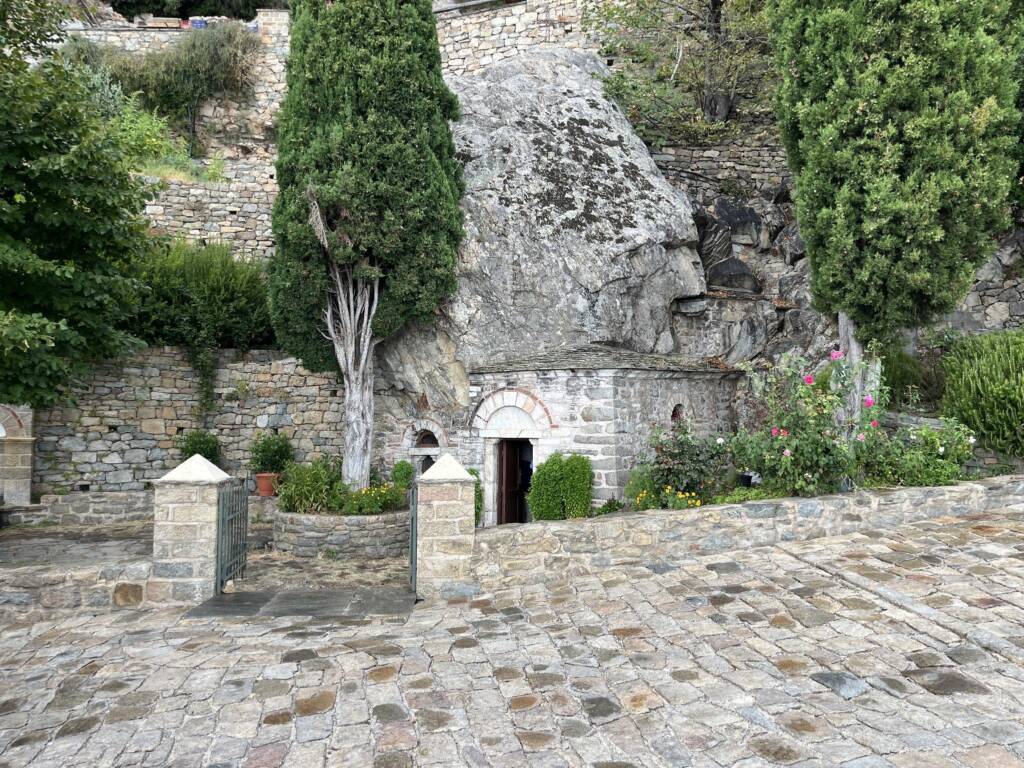
According to tradition, Saint Simon, who lived here in the thirteenth century, saw a light like a star on the rock opposite him on the night of Christ’s Nativity. He received a divine sign recalling the cave of Bethlehem and was charged with building a monastery on that rock. For this reason, Simonopetra’s main church is dedicated to the Nativity of Christ, and the monastery has been called New Bethlehem. Standing in the cave, I thought that Simonopetra’s seven stories were a prayer offered in that tiny place made stone. The rock had first sheltered a hermit; later it carried a brotherhood. A cave entered in search of solitude eventually became the source of a shared life for hundreds. True retreat does not sever us from our brothers; it allows us to return to them with a more purified love.
Saint Paul’s words, ‘We are hard pressed on every side, but not crushed; perplexed, but not in despair,’ suit Simonopetra’s history. Fires pressed upon it, pirates threatened it, taxes and debts exhausted it, and the geography of the precipice made every repair difficult. Yet prayer did not cease. The monastery’s miraculous quality lies not in having been shielded from history but in its ability to stand firm through all of history’s blows, each time with renewed strength.
Returning from the Holy Mountain
As I left the three monasteries, I carried three vivid images with me: the metal Janissary like figure striking the clock at Vatopedi, the skulls arranged on shelves at Xenophontos, and the small cave from which the great monastery above the precipice at Simonopetra had grown. The clock taught me that my hours are not my property; the bones, that outward appearance cannot be our ultimate measure; and the cave, that things which seem great and lasting often spring from hidden faithfulness.
When we returned to the world, mirrors, clocks, and screens were waiting for us again. The life proposed by the Holy Mountain joins time to prayer, the body to restraint, memory to community, and stone to humility. The monks’ resembling faces, elderly Barlaam’s face that he did not recognize, Monk Spyridon’s joy among the bones, the books safeguarded by Hieromonk Makarios, and Mihai Viteazul’s engraving on the wall all meet around the same truth: we cannot preserve ourselves alone. We are sustained by our bond with those who prayed before us and those who will continue singing the same hymn after us.
For this reason, leaving Mount Athos did not feel like a final parting. The sea came between us, the gates closed, and the watch on my wrist and my mobile phone regained their hold over me. Yet the rhythm of the monasteries remained within me as a measure. Perhaps we never entirely return from the Holy Mountain. The silence we receive there remains inside us like a small cave amid the noise of the world. The real question is not whether we have left Mount Athos, but whether we can return to our familiar world as the same person. I did not return as the same person!
Mikhail SOYDAŞ

